

In real life, airsoft and tactical paintball games, the ability to scoot and shoot is a prized skill that separates the survivors from the casualties. A team that is able to maneuver on the fly while keeping the opposing team down with suppressive will more often than not outflank the enemy and cut them down. Although the urge to hunker down and stay put often seems more preferable than charging towards the enemy, the one hiding in the hole will always be at the disadvantage because the other team will have the initiative. And pretty soon, the ones who are hiding will find their teammates slowly being decimated until there is no one left. In the following article from Wikipedia, the basics of Fire and Maneuver is outlined perfectly, and shows the reader why this is one of the most effective tactics to date.
From Wikipedia, the free encyclopedia
Fire and movement is the basic military tactic used by small unit commanders on the modern battlefield. It uses the power of suppressive fire, or threat thereof, to decrease the enemy's ability to return fire, its organization and unit cohesion, its intelligence through suppression, and morale. The "Movement" part of the action, consists of a separate organizational unit moving forward in greater safety afforded by the suppressive fire laid down on the enemy.
Overview
Fire and movement works on the basis of a section of, or entire military unit suppressing the enemy with an appropriate level of fire, while at the same time, another section of, or entire military unit advancing. This will take the form of two units of whatever size appropriate, be it two soldiers or larger. Enemy suppression can also be achieved with direct and/or indirect fire from combat support units. Artillery, mortars and armor are a few examples of combat support units often used in fire and movement tactics.
In the United States Military, a basic fire and movement tactic is called overwatch. There also exists several variations of overwatch, generally adding further description to more accurately describe the specific maneuver.
A unit fires upon an enemy to distract or suppress them allowing another unit to assault, flank or encircle the enemy. The enemy will be pinned down and can not react, and will be forced to take cover until the flanking unit engages them.
Suppression
Heavy and continuous fire keeps an opponent suppressed and therefore limits the overall firepower of a unit (if a platoon has 30 soldiers, but only 15 are shooting back because the other 15 are being suppressed, that unit's firepower has been reduced by 50%). The fire cuts down on an enemy's intelligence in that they are not able to assess the situation clearly.
Advance
While a base of fire is set up, the second unit will advance to cover in front, in the process setting up a new base of fire at this point.
After a new base of fire has been set up the first unit will advance, under cover of the new fire base, to a new position and set up another base of fire.
Assault
This is repeated until the units have closed upon the enemy position. At this point a unit will close in on the enemy and destroy them. Often throwing grenades, close-quarters combat techniques, and hand-to-hand combat.
Friday, December 7, 2007
Fire and Maneuver

Thursday, December 6, 2007
The Value of Overwatch (Sniper Lookout)

In airsoft or tactical paintball games, the position of sniper lookout or overwatch is sometimes the least desired position in a team. By its very definition, a person assigned as overwatch is rarely allowed to engage prematurely and most of the time has to operate separate from the team. Such situation leaves the sniper lookout often in a vulnerable position, where he faces most of the guns of the opposing team if he is detected. As such, most players shun the sniper lookout for the run and gun positions preferred by most of the team’s members.
But employed expertly, the sniper lookout can be a true force multiplier for the assaulting team. Because his role is mostly intelligence gathering, the overwatch officer provides the team with a heads up on enemy dispositions and orientation. He can also snipe down exposed enemy officers while the rest are distracted by the assaulting team. And in case of retreat, the overwatch position becomes a vital covering fire zone, slowing down the enemy while the rest of the team escapes.
Training scenarios and real CQB situations depend on the overwatch officer for a higher rate of success in missions. Often times, SWAT ground commanders will place several overwatch positions in buildings adjacent to the location to be assaulted, with the lookout officers relaying real-time data about bad guy activities to the team.
During the actual assault, the overwatch position can be used as a vital source for harassing or covering fire. Fire from the overwatch officers keep the bad guys heads down and keeps them busy while the real assault team begins the final approach for dynamic entry.
Study on ways how your team can deploy an overwatch during your operations. Because in the game, as in real life, the shooter who can see the farthest and has the most intel will be the ones who will survive.
Monday, December 3, 2007
Small Unit Tactics
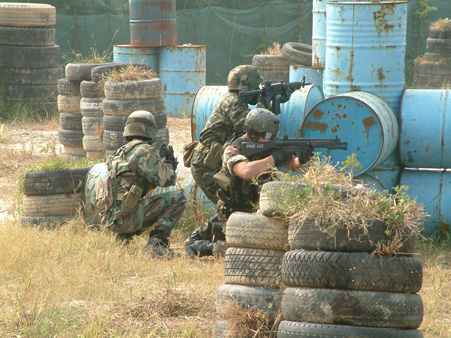 In developing skills that would enhance a team's CQB tactics, one must also rely on established disciplines and proven tactics that can greatly increase proficiency of the group. Moreso in Real Action Marker training scenarios and tactical paintball, these tactics will also help increase survivability while enhancing the effectiveness of the team. The following article written by Squeegie outlines one such tactic, namely the Interdiction Team Tactic. It illustrates the composition of the team, as well as details the roles of each member of the group. Mastering this tactic will allow a small team to function and even be a credible threat to squads double their size.
The Interdiction Team Tactic
The small attack squad is a compact unit that is primarily used to spearhead attacks, or start a battle on a separate front. Sometimes referred to as "Interdiction" teams, these small squads are excellent tools for commanders. The small crew can easily penetrate into areas unseen, cause havoc, and move on to another objective. The interdiction team is no smaller than three members, but may exceed as many as 6 to 12 comprised of three man cells. We will look at what makes up a good interdiction team, the root of the team, and basic Interdiction tactics.
The Root
The root refers to the basic core of the team. Three players, all with a specific duty, but able to perform the duties of the other members. It is very critical that the other members are able to change duties at the drop of a hat. This gives the team more diversity and able to quickly adapt to any problems that may arise. The root team must also be very familiar with one another’s style of play. The players should have been playing together as a team for a very long time, and know what each others strong points are, as well as their weaknesses. This cohesion is critical. It should almost be second nature to know what the other teammates are going to do.
The team is broken down into three duties. Point, Sniper, Suppressor. These are your basic fundamental duties. Each player will use one another as a tool for the collective goal of completing the objective, be it overrunning a bunker or ambushing a squad. Know what your role is and stay focused your job and the objective. Lets take a close look at the roles.
Point
Point works like a typical point man normally works. He is the eyes and ears of the squad. Usually running almost out of the sight of the rest of the quad, he locates the enemy and advises the rest of the squad on what course of action they should take to handle the approaching threat. When the firing starts, the point man acts as either a flank attack or bunker runner. The point man will do a lot of moving to say the least. He needs to be quick on his feet, have a good eye for spotting hidden enemy, and be able to access a situation clearly to allow the other members to understand.
Sniper
Just as the name suggest, the sniper is the stealth end of the squad. He uses his talents as a force multiplier for the squad. Precision shots, stealth flanks, and drop back retreat ambushes all fall under the duties of the Interdiction Sniper. Usually wearing a ghillie, they are also used during the attacks as a means to eliminate the frontal attacking force while other members of the team provide covering fire. Once in place, the sniper can provide the same covering fire to allow other members of the team to advance. The sniper must be able to move quickly but quietly, and deliver accurate shots the first time. This is not the role for a pump gunner though. The sniper must also be able to rattle off the shots to help get out of bad situations, or provide covering fire for other members of the team.
Suppressor
This is the heavy machine gunner of the team. He is the man laying down the wall of paint. He keeps heads behind bunkers and enemy looking for cover. During his rain of terror, he is allowing the other members of the team to push forward under the safety of his bunker of paint. The suppressor needs to be fast on the trigger, carry a lot of paint, and not afraid to shoot no matter what. He is keeping the enemy pinned down, so he must be able to shoot & still keep his cool no matter how close the balls are getting to him.
Interdiction Squad Tactics
All the tactics for the team revolve around the same basic plan. Know this basic plan, and you can pretty much make your way through anything that presents itself.
Basic Plan
The basic plan revolves around simple principles. Point man provides the intel, plan of attack is laid down, suppressor applies pressure, sniper and point take flanks. The job of the suppressor is transferred to other team members to allow one another to move forward. It is simple, but very effective. Lets look at how this basic plan is used to take control of an enemy fort.
Basic Plan - Attacking Fortified Structures
Attacking any fortification should be done with recon first. Your point man should make his way as close as possible to gather intel about the number of enemy occupants, areas of defilade fire, and avenues of escape should things get ugly. Once he has relayed said information, the rest of the team moves in. The set-up is important. All team members must be in place before the attack is executed. Interdiction teams rely on surprise to confuse and rattle the enemies’ nerves. Try to establish the team in as wide of a pattern as possible. The unit should be in a "C" formation. This will help to prevent the team from being flanked. The sniper should be on a far flank, point on the other, with the suppressor located in the middle toward the back with a field of fire that spans the entire group.
The point man and the suppressor should take the first shots. They need to eliminate targets with these first hits. This will cause the enemy to scramble to replace the positions, thus buying you some time. After the first strike, the suppressor lays it on thick. He stays on the trigger to keep everything with half a brain ducking for cover.
Now we bring in the sniper. He uses this chaos to move up and get a closer position, preferably to cover the entry point for the team. The point man should move up as well and take over the job of the suppressor. This allows the suppressor to move forward and continue his blistering volley of gelatin-encapsulated fury. Once the suppressor is back into position, the rest is up to the sniper and point man.
The sniper should have a good bead on the interior of the building by now, so he needs to begin taking out targets of opportunity. With this new angle being compromised, the enemy will now have to contend with fight on two fronts. This will give the point man and the suppressor the chance to rush the structure, since the snipers fire now covers them. With the two attackers moving in, it is pretty mush a free for all.
Once you are inside, cover one another and acquire your targets quickly and accurately. If you are going to be hit, your chances are three times as good that it will happen once you breech the doorway. If you keep your cool, you will persevere. Congrats, you just took and enemy fort with three players.
Saturday, December 1, 2007
Cardinal Rules of Gun Safety
 Gun Safety is Everyone's Responsibility!
ATACS Advanced Tactical Training Services was envisioned to be primarily a partner in training for Philippine Law Enforcement, Armed Forces and Private Security Agencies. Although employing non-lethal simulation training rifles and pistols, the mental discipline of gun safety should always be applied.
True, the Real Action Marker is not capable of killing a person. But one can still be blinded unless wearing appropriate protective equipment. Put more importantly, training with the RAM means that you are harnessing skills that you will later use when holding a real firearm. As such, being ignorant of gun safety rules means you are inviting disaster. Showing lack of respect when using RAM will more often translate to lack of respect for your real gun.
Firearms safety transcends mental and physical discipline - it is a way of life for all those who are and who wish to carry arms. Guns and the Real Action Marker are tools; used properly, both are useful and enjoyable tools.
Thus ATACS advocates everyone using the RAM to learn at heart the four Cardinal Rules of Gun Safety. It will prevent you from accidentally hurting yourself or someone else. Remember, there is no such thing as accidental discharge, only criminal negligence.
Rule # 1: All Guns Are Always Loaded
All guns are always loaded. ALWAYS! Unless you have checked it yourself, always assume that the gun is loaded, and that you have verified its condition. Don't rely on the word of anyone else. The gun in your hand is also your responsibility, therefore any incidents that occur with it will make you liable for it.
When picking up a RAM rifle, check first if the safety lever is set on the safe position. But even if it is on "safe" don't point the gun around indiscriminately, because if the trigger unit has a leak, the gun will still fire and hurt someone. Next, check the ejector port to see if a paintball shell is loaded. Quick tip: If you see silver, it's loaded. If you see only black, that means the maglock is engaged and the rifle is empty.
For RAM pistol, there is no safety switch. In order to ensure that it is loaded or not, eject first the magazine. Then pull back the slide to see if a round is chambered. If there is a paintball loaded, locate a safe area, a blank wall or container and point the gun towards it, then discharge the round.
Rule # 2: Never let your muzzle cover anything that you are not willing to kill.
Never let your muzzle cover anything that you are not willing to kill or destroy. You must always be aware of where your gun is pointed. Never let it point at anyone or anything that you don't want to shoot.
The same is true for the RAM as with the real gun, because both shoot projectile that can cause certain levels of injury. Like in rule number one, the safety on the RAM rifle may not fully engage if the trigger unit has a leak. Thus if you point your RAM at anything that you are not intending to shoot, the gun might fire on its own due to the malfunction and you might end up hurting someone.
If your gun is never pointed in an unsafe direction, then no one can be harmed by it, even if you do something stupid. You MUST exercise due care when handling a gun or your RAM. Even if you know the RAM is empty, don't let it point at anyone, unless the instructor has given you the order to begin the force-on-force training session.
Rule # 3: Keep Your Finger Off the Trigger & Out of the Trigger Guard Always.
Simple and effective. Keep your finger off the trigger and out of the trigger guard until your sights are on target, and you have made the conscious decision to shoot. This is especially important when using the RAM in force-on-force training. Indiscriminate firing can lead to unintended injuries to members of your team.
Another reason for this is basically neurological - the primitive brain and man's natural self defense reaction is to tighten up every muscle in the body when startled, including the trigger finger. So if your finger is on the trigger at all times, when the shooting starts, you might end up pulling the trigger by accident. If your finger is out of the trigger guard and along the frame, you will not be in danger of shooting by mistake.
Rule # 4: Be Sure Of Your Target And What's Beyond It.
The hand that holds the gun is responsible for whatever is done by that gun. If you launch a bullet, you are responsible for it, no matter where it lands. When using RAM for training or recreation, you will also be responsible for whatever you hit.
Know your target and what lies beyond it is the essence of force-on-force training with RAM. This is not a movie wherein all the tangos line up for you to shoot down one by one. They shoot back. They can use hostages, usually members of your own team or training class. They might be hiding in an area where your teammates might soon emerge, thereby creating a situation for friendly cross-fire. Worse, there might be bystanders, spectators or even marshals near your line of fire.
As such you must know the capabilities of your RAM, what damage it can do to a person a long or short range. You must also be certain where your shot will go when you fire, what you might hit if your miss your intended target. And although the paintball round will not penetrate, you assume in training that you are using a real gun and thus you must also assume that the ammo will go through the target and hit something else.
Before you fire, look over the intended path carefully. If it's not safe to shoot that way, don't. If you have to shoot, and it's not safe to miss, then you better not miss. Find a way to win. Change the background by moving, or change the angle by kneeling.
REMEMBER training with the RAM means: You train like you fight in order to fight like you train. Be mentally prepared. Respect your Real Action Marker, not as a toy but as an effective training tool that it was envisioned to be.
Close Quarters Battle
 From Wikipedia, the free encyclopedia
Close Quarters Battle (CQB) or close quarters combat (CQC) is a type of fighting in which small units engage the enemy with personal weapons at very short range, even to the point of hand-to-hand combat. In the typical CQB scenario, the attackers try a very fast, violent takeover of a vehicle or structure controlled by the defenders, who usually have no easy way to withdraw. Because enemies, hostages/civilians, and fellow operators can be closely intermingled, CQB demands a rapid assault and a precise application of lethal force. The operators need great proficiency with their weapons, but also the ability to make split-second decisions in order to limit friendly casualties.
Criminals sometimes use CQB techniques, such as in an armed robbery or jailbreak, but most of the terminology comes from training used to prepare soldiers, police, and other authorities. Therefore, much CQB material is written from the perspective of the "good guys" who must break into the stronghold where the "bad guys" have barricaded themselves.
Although there is considerable overlap, CQB is not synonymous with urban warfare, now sometimes known by the military acronyms MOUT (military operations on urban terrain),FIBUA (fighting in built-up areas) or OBUA (Operations in Built Up Areas) in the West. Urban warfare is a much larger field, including logistics and the role of crew-served weapons like heavy machine guns, mortars, and mounted grenade launchers, as well as armor and air support. In CQB, the emphasis is on small infantry units using light, compact weapons that one man can carry and use easily in tight spaces, such as submachine guns, shotguns, pistols and even knives.
Principles of assault
Detailed planning
300px-team-approach2.jpgIdeally, the leader of the assault team gathers all available intelligence about the crisis scene, targets, and innocents. He diagrams and discusses the proposed plan, outlining each team’s actions and responsibilities, location, fields of fire, and special tasks (even to the point of a wall-by-wall and door-by-door layout of the objective, where available). Since the assault team usually already has specialized training, the operation is based on well-understood, pre-established standing operating procedure. When considerable preparation time is available, the team sometimes conducts step-by-step walk-through exercises on a mock-up that duplicates the target environment. Some units maintain permanent "shoot houses" or even airliner/ship mock-ups for practicing marksmanship and tactics more realistically.
In a prolonged standoff, the attackers can sometimes bring in specialized equipment for probing the inside of a well-defended area. Sensitive thermal cameras can help locate the occupants, and surveillance personnel can run microphones and fiber-optic cameras through walls, ceilings, and floors. The "throw phones" used to establish contact between authorities and suspects often contain hidden cameras or infrared illuminators for added intelligence-gathering. If hostages escape or can communicate/signal the attackers, they can provide more information from inside.
However, the time and resources to carry out such luxurious preparations are not always there. Not every attacker can field an overwhelming force of specially trained and equipped men with reinforcements standing by. Information about the inside of an enemy-held building or vehicle may not be accessible beyond studying it through binoculars or a rifle scope. While some attackers can go to the lengths of wearing the enemy down by siege or even tunneling under them, others must get the current job done immediately with the force available in order to move on to the next.
Surprise
300px-team-moving-out.jpgThe objective is to complete all offensive action before the party being engaged is able to react. To gain this element of surprise, the entry teams use stealth movement and noise/light discipline to get as close to the targets as possible, hopefully putting themselves in a position to engage an enemy from the moment he becomes aware of them. Some teams use subsonic sniper rifles for their initial shots on sentries or dogs.
An assault should come at a time when least expected, taking into consideration fatigue, normal sleep periods, and other factors that detract from the target's alertness. Diversions are an essential element in achieving surprise. Staged emergencies, such as a mock auto accident, fire, or explosion near the crisis site, can divert the target's attention away from the assaulting elements. Explosive breaching and diversionary devices, such as flash bang, smoke, or gas grenades can be employed to distract and disorient the targets. Negotiators can try to manipulate the defenders into a more vulnerable position or convince them that their position will not be stormed.
Methods of entry
When law enforcement clears a building, they usually work in a slow and deliberate manner using ballistic shields and mirrors for searching. This affords the highest degree of safety and security for the police, as well as any uninvolved bystanders inside the search area, who can be identified and safely removed without subjecting them to the shock and danger of a sudden assault. When suspects are encountered, the police can confront them with an alert, armed force and try to take control without shooting. If the searchers meet heavy resistance, they can usually pull back without harm and prepare for a dynamic entry.
However, against determined, well-armed opponents who fight in concert to defend an area and keep it under their control, slow stop-and-go movement can cause the deaths of many attackers and hostages. That leads to dynamic entry, used in military operations or hostage rescues. It is the popular image of CQB: a flood of gunmen who burst in without warning and attempt to seize the area. Dynamic entry tactics must be rapid and aggressive, ideally a continuous flow using overwhelming force that does not stop until the threat is eliminated.
In the vast majority of hostage rescue and other dynamic CQB operations, it is desirable to use multiple simultaneous attacks from different entry points to overload the target's ability to react effectively. The more entry points the attackers can choose from, the better their chances. The teams actually entering the objective usually have to synchronize with snipers, negotiators, power technicians, perimeter guards, and others who assist from the outside. Medical personnel, investigators, and bomb experts may be prepped to enter the scene as soon as the initial attackers get control.
It is important that a central commander coordinate all armed elements, not only to better complete a sweep of the target area, but especially to guard against friendly fire. Most assault rifle bullets can go straight through an enemy and still exit with enough force to kill again, so letting enemies get between two attackers (or attacker and hostage) can easily lead to fratricide. Pistol rounds and shotgun pellets carry less risk of overpenetration through a human body, but on a miss, they can still blast through several sheets of drywall and kill unseen people on the other side. When large areas must be searched, leaders will assign boundaries between elements and track them by radio to ensure they do not interfere with each other. The goal is to establish overlapping fields of fire, so that multiple shooters can attack at once from different directions without danger of hitting one another.
Speed
Once the assault begins, the team must gain control before the target understands what is happening and can prepare an effective defense or mount a counterattack. The defenders sometimes have a contingency plan that could cause the attack to fail instantly, such as killing hostages, detonating bombs, or destroying evidence. If they can execute an organized plan, such as falling back into a prepared stronghold, or breaking through the perimeter, the possibility of friendly casualties increases. Speed is achieved through well-designed tactics, such as gaining proximity with an undetected approach, the use of multiple entry points, and explosive breaching. Note that the need for speed does not necessarily translate to individual operators choosing to run in these situations.
Violence of action
For the dynamic entry team, gaining and maintaining physical and psychological momentum is essential. They smash down doors, blast holes in walls, come through windows, and drop from helicopters. Vehicle-mounted rams and platforms are used to create unexpected entry points. The sensory onslaught from tear gas, explosive breaching, flashbangs, and gunfire is complemented by the intimidating and aggressive actions of the assault team. Hostiles do sometimes hide among the hostages, so once the shooting has stopped, operators must maintain dominance over anyone still alive.
The defenders try to stop enemies close to the entry points. The "fatal funnel" is the dangerous area where the assaulter is silhouetted against his own entry point from the perspective of defenders inside the room. Once operators begin to enter, the defenders try to keep them from escaping the fatal funnel. The attackers are also vulnerable from the corners closest to the entry point, the first place from which they can be hit from behind as they enter the room. If the first attackers cannot clear the corners and get out of the fatal funnel, allowing those behind to move in and help, the attack can bog down.
Military
Military uses of close quarters battle vary by unit type, branch and mission. Military operations other than war (MOOTW) may involve peacekeeping or riot control. Specialized forces such as the U.S. Coast Guard or U.S. Navy VBSS (Visit, Board, Search, and Seizure) teams may adapt CQB tactics to their specific needs, e.g. for the boarding compliant and non-compliant vessels at sea. Hostage rescue or extraction by commando troops such as the British Special Air Service, Delta Force or U.S. Navy SEALs may involve even more esoteric adaptations or variations, depending on specialized environments, weapons technology, political considerations or a mixture of friendly, unfriendly or civilian personnel.
Armies that often engage in urban warfare operation may train most of their infantry in basic CQB doctrine as it relates to common tasks such as building entry, "clearing a room" and concussion and other grenades.
Police
Domestically, police crisis response teams (CRTs) are the primary groups to engage in CQB. Situations involving the potential for CQB generally involve extraordinary threats outside of conventional police capabilities, and thus CRTs are specifically organized, equipped, and trained to respond to these situations. These situations often require the special tactics and techniques involving building entry and room clearing procedures that are the hallmarks of CQB.
Police CQB doctrine is also specialized by unit type and mission. Riot control, corrections, the FBI Hostage Rescue Team and SWAT teams, for example, each have different goals, but may make use of similar tactics and technology such as non-lethal force. A prison, for example, may have a squad which specializes in high-risk cell extractions, and psychiatric hospitals or wards often have similar specialized teams. Among the "less-than-lethal" tools and tactics central to police CQB are electroshock guns, pepper spray, riot shields and riot guns to fire tear gas, rubber bullets, plastic bullets or beanbag rounds. All so-called "less-than-lethal" weapons can inflict injuries which may cause death.
Private industry
Private corporations engaged in security or military operations overseas maintain internal CQB teams. For example, these teams might be responsible for responding to an incident at a facility operated by a government agency who has engaged the contractor's services. That team would then act as the Crisis Response Team (CRT) and "clear" the facility of threats or hostiles. In another example, Military corporations or Private military contractor might be employed to provide protection for high-ranking diplomats or military officers in war zones.
Thursday, November 29, 2007
Real Action Men field tests the Real Action Marker
As part of its initial promotional efforts of the RAM in the Philippines, ATACS Advanced Tactical Training Services recently invited the officers of the Regional Special Action Unit (RSAU) to include the new Mark V RAMs in one of their field training exercises (FTX).
Their reaction was spectacular!
The Regional Special Action Unit (RSAU) of the Philippine National Police is part of the training force that provides SWAT instruction for most SWAT teams in the country. Among their members are highly trained officers that have received schooling in counter-terrorism and urban warfare in the US.
During their FTX, the RSAU replicated a sniper-initiated assault on a four-storey tower, complete with designated rappel, ladder and entry-assault teams. Members of the RSAU designated as “hostage-taking terrorists” began exchanging fire with the assault force, adding to the realism of the simulation. After the shootout, the RSAU assault force rescued the hostage, “killed” three terrorists and captured one without a single loss on their part.
“The Real Action Marker of ATACS is a very realistic tool for tactical training and a must for law enforcers to experience, to enhance and to prove the effectiveness of their tactics,” stated Maj. Rex Malimban, Chief 3rd Coy, RSAU, a dynamic commendation for the recent entry of the RAM in the Philippines.
ATACS is also hard at work in providing live-fire demonstrations for elements of the Makati SWAT, the Philippine Airport Police and the Philippine Marines in the coming weeks.
“It is very important to remember that aside from being a realistic replica paintball gun, the RAM is an effective and cost-efficient alternative for tactical simulated ammunitions training,” stated Jasper Briones, Managing Director for ATACS Advanced Tactical Training Services. “We believe in the potential of the RAM and we trust in the products of our partner APS Paintball Ltd.

Makati City police training exercises go high-tech

The Philippine Star
Makati City’s officers from its elite assault and tactical operations team staged an anti-terrorist training exercise Tuesday using training guns used by the United States military and police personnel.
With Makati police chief Superintendent Gilbert Cruz and other officials playing terrorists, commandos of the Special Weapons and Tactics Team (SWAT) and other units of the Makati police tested the guns, which are designed to help police and soldiers sharpen their skills without getting anybody killed.
Known as the Real Action Marker (RAM), the "simulated ammunition" guns are rapidly gaining popularity worldwide as a safe and effective training tool for simulation training and live-fire exercises.
Exclusively marketed in the Philippines by ATACS-Advanced Tactical Training Systems (ATACS-ATTS), the guns are far more advanced than paintball and airsoft guns, and are meant for the kind of training needed by the military and the police.
In the exercise, Cruz and other officials played terrorists and took up positions on the fifth floor of an abandoned school while SWAT policemen hunted them down.
Both sides suffered "wounded" and "casualties" but the SWAT officers won.
"It was a great experience," said Cruz, adding that he will recommend the guns to the Philippine National Police for training exercises. Cruz was able to “kill” three SWAT officers before he was shot dead.
ATACS founders Jasper Briones, Jose Viven Balsomo, Jose Luis Valdes and Michael Salvador said the RAM training system they offer will provide affordable and modern "simulated ammunition" training systems for the PNP, the Armed Forces of the Philippines and security agencies.
According to Briones, the RAM guns are essentially a hybrid of the paintball and airsoft designs already in use Wednesday. They combine the best of both worlds in a replica firearm of the same size and shape as a Colt M4- or M-16 rifle. It also uses a paintball projectile that effectively marks hits via paint splotches.
Briones said the realism of the RAM design also features a magazine-fed ammunition loading system that can hold up to 20 rounds of paintball ammunition.
"Another unique touch in the RAM concept is the alloy casing that encloses the paintball round, protecting it while it is in the magazine and is ejected during firing to simulate the shell casing ejection of a real rifle," Briones said. "The CO2 propellant tank for the rifle itself is concealed within the stock of the RAM, making it an unobtrusive part of the simulated ammunition rifle."
Briones said the RAM is a very realistic tool for tactical training and a must for law enforcers to experience so as to enhance and to prove the effectiveness of their tactics.
He noted that the arrival of ATACS in the Philippines and RSAU’s field test makes the country only the ninth in the world to employ the RAM as a training tool for law enforcement.
The other countries now using RAM are Australia, the special administrative region of Hong Kong, Malaysia, Nepal, China, Singapore, Taiwan and the US.
In the United States, 15 law enforcement agencies use the RAM system, while two military installations have incorporated the technology in their training programs.
Affordable Simulation Training now in the Philippines

In western countries, several modern forms of training have been developed to increase the operational readiness of their law enforcement and military forces. One of which is known as the force-on-force simulated ammunition training, wherein the stresses of real-life combat encounters and tactical scenarios are simulated using non-lethal training technology.
Such simulation scenarios allow instructors and trainees to train as closely as possible to the real thing without accidental injury or loss of life that comes when using blank cartridges or real-weapons modified for training.
The most accurate simulated ammunition technology known today is the MILES gear, employed by US forces and local police. The acronym stands for Multiple Independent Laser Engagement System, which employs a combination of modified weaponry, laser emitters and a computer-controlled system of laser receivers, that pin-point the exact trajectory of the simulated bullet. Hits are recorded via the computer system and the unfortunate trainee is alerted by a continuous electronic alarm signifying his “death”.
However, such a system can be costly to set up and can not be easily transported to another location, thereby limiting the choices of scenarios available.
Other law enforcement agencies who have also recognized the value of “simulated ammunition” training have experimented with alternative gear that could help enhance their training regimes, while costing a fraction of the cost of a dedicated MILES system. They found their choices in paintball and airsoft systems.
Paintball was of course the first apparent choice for simulated ammunition training, because of its capability to mark hits with paint splotches. This ability was highly significant since an instructor could easily identify the trainee that had been hit, as well as which part of the body the “bullet” impacted. But this useful trait was also offset by several negatives – the paintguns did not resemble the size, shape and weight of a real gun; an ammo cannister that holds the paintball ammunition effectively blocks the sights of the gun itself making it hard to aim at targets; and a gravity-feed system that does not allow the gun to be fired unless in the prescribed upright position.
Others began to switch to airsoft guns as training tools due the fact that this system featured a replica design, making them look, feel and even weigh like the real thing. Powered by battery or compressed gas and firing “ballistic ball” (BB) pellets, airsoft rifles offered more training potential in terms of movement and marksmanship.
Users, however,also noted that airsoft required an honesty system, since the BB pellets do not leave marks whenever they hit. Often times, during the rush of adrenalin, some trainees would fail to register hits and would continue to shoot even after effectively being “killed” by an opposing force. This crucial factor has made the training value of airsoft systems somewhat lacking, although its entertainment value as a hobby continues to grow steadily today.
“The Real Action Marker is essentially a hybrid of the paintball and airsoft designs, combining the best of both worlds - a replica body of the same size and shape as a Colt M4 or M16 rifle and a paintball projectile that effectively marks hits via paint splotches,” stated ATACS Managing Director Jasper Briones.
Briones further explained that realism of the RAM design also features a magazine-fed system that can hold up to 20 rounds of paintball ammo. Another unique touch in the RAM concept is the alloy casing that encloses the paintball round, protecting it while it is in the magazine and is ejected during firing to simulate the shell casing ejection of a real rifle. The CO2 propellant tank for the rifle itself is concealed within the stock of the RAM, making it an unobtrusive part of the simulated ammunition rifle.
The realism and training potential of the RAM design itself was tested in full when ATACS ATTS offered the new simulated ammunition rifles to be tested by members of the 3rd Coy, Regional Special Action Unit (RSAU) during one of their field training exercises in Camp Bagong Diwa.
The result was dynamic, as the RSAU replicated a sniper-initiated assault on a four-storey tower, complete with designated rappel, ladder and entry-assault teams. Members of the RSAU designated as “hostage-taking terrorists” began exchanging fire with the assault force, adding to the realism of the simulation.
After the shootout, the RSAU assault force rescued the hostage, “killed” three terrorists and captured one without a single loss on their part.
“The Real Action Marker of ATACS is a very realistic tool for tactical training and a must for law enforcers to experience, to enhance and to prove the effectiveness of their tactics,” stated Maj. Rex Malimban, Chief 3rd Coy, RSAU.
Briones revealed that the arrival of ATACS in the Philippines and the field test of the RSAU makes the country only the 9th in the world to employ the Real Action Marker as a training tool for law enforcement.
Among the other countries now using RAM are Australia, Hongkong Malaysia, Nepal, P.R. China, Singapore, Taiwan and the United States. In America, 15 law enforcement agencies already use the RAM in the training, while two military installations have incorporated the revolutionary simulated ammunition rifle in their training regimes.
Briones also shared that while the ATACS RAM rifles are available for retail purchases, law enforcement and military instructors may also avail of the company’s Engkwentro Xperience, an equipment rental service that offers RAM simulated ammunition rifles, complete with protective gear. Paintball ammunition consumed during training, however, is charged separately.
“The ATACS Engkwentro Xperience is a cost-effective way to allow our law enforcers, special military units and even security agencies affordable access to the RAM without the added worries of maintenance. We can go to their training site, equip their trainees easily and they can concentrate on enhancing tactics and strategies of their men,” stated Briones.
ATACS ATTS is the sole authorized distributor in the Philippines for the Real Action Marker. The simulated ammunition rifles are imported from and manufactured in Hongkong by Asia Paintball Ltd.
For inquiries about ATACS, the Real Action Marker and the Engkwentro Xperience, please contact 882-3550, or email us at atacsphil@gmail.com.

